Pages

Saturday, September 27, 2014

Cutting up an old friend: the life and times of a suburban tree.

I'm back in the northeast for a bit. My parents had to have an old white oak (Quercus alba) removed from our yard, as it hung over the driveway and the house and dropped a big branch on my dad's car last year. The two trunks stood less than a meter from the driveway and it was shaded on one side by tall white pines (Pinus strobus), the other side by the house and sheltered an understory of pokeweed and poison ivy. Notably, in the mid-90's, I spent considerable time in a rickety treehouse between the two trunks. More recently, I'd watch migrant warblers in the spring and fall and chickadees, nuthatches and creepers in the fall on it - for awhile a suet feeder hung which we watched from the kitchen windows.

The author in the tree "house", 1993. The author is 5, the tree ~ 90.
I only know the history of the tree since ~1991 (and those early years, I don't actually remember). But the removal of the tree offered the opportunity to see its history. What had it seen? How old is it? Did the building of a house/driveway next to it cause it any harm? It was obvious from the start that this "tree" started as two individual oaks, which then joined (inosculated is apparently the correct term for this - see some striking examples here)

Days before its demise. 2014. 
Chainsaw marks had made reading the rings difficult, so I sanded a line on each side of the stump and tried to make out the rings.

In progress. The far right side of this photo actually is asphalt, though hidden under debris - the tree was only 

What I found, indicated that I needed to do more work. A set of really thin lines occurred in the early 1970's on one trunk and late 1970's on the other. So clearly I couldn't delineate them accurately. What caused those really lean years, I figured initially must have been the construction of the house and the building of the asphalt driveway practically on the tree.

Something is wrong here! Blow this up to see better. 
Therefore, my dad and I planed the whole stump (until the planer broke, ~50% done). This allowed us to also see clearly the junction of the two trees.

So what caused that big set of lean years, now correctly dated as 1976-1982? The house was built in 1982... the driveway a few years later - that certainly didn't cause the lean years as I had initially hypothesized. So what happened?

Now, a couple hours later, they line up!

Let's construct the history of the tree. Because the planer broke before I could get to the very center, I actually don't have good resolution the first couple years. The left trunk (father from the driveway), looks to have put down its first ring in ~1900, the other a few years later, ~1904. What was happening in Wrentham at that time? In 1870, Wrentham had 2202 people, 1900 - 2720 and 1910 - only 1748 people. I suspect that loss of populations corresponded with the degradation of farmland, and increased exports of agriculture from the great plains (at least this is what I remember from a New England environmental history course in college). A large dairy farm up the road - Birchwold Farm, now a great conservation area (best place to find black racers around Wrentham) - folded at about the same time.

Had the tree been paying attention to world events, it might have noticed these (a smattering of things I could think of
no rhyme or reason to them). 
So these trees took root - not a meter apart, in the first decade of the century or slightly before on what was likely fallow farmland reverting to mixed deciduous forest - what most of New England has gone through at one point or another. They then grew steadily through the next few decades until 1944-1946, when growth slowed to an inchworm's pace for both stems. Many factors could slow a tree's growth in this way including drought, this hurricane, an abnormally short growing season, an ice storm (leading to loss of healthy limbs), or insect outbreaks, to name but a few. Which ones contributed to this, I don't know, nor can I find any information on anything abnormal happening in that period (but do let me know if you do!).

The next big hit the trees took was in the late 1970's - 1980's. At first glance, the cause is obvious: the two trees hit. When this happened, they seem to have put much effort into wood building at the junction - perhaps as a form of competition - as the lines are quite wide at the junction, but get infinitesimally small around the other 3/4 of the trunk. This period is why I didn't get equal counts from the two trees. Even with a hand lens, I couldn't make out the lines accurately on the first area I sanded. In the center of the junction a crack is visible - this is where vascular tissue never grew, I suspect the soft material in the center is old, compacted outer layers of bark which had nowhere to go when the fusion happened around them.

A branch with some sort of rot - I presume fungal. 
But I suspect that is not the whole story. 1981 was the worst year for both trees - they put on pretty negligible growth even in the usually fat junction area. I suspect this was due to the worst ever infestation of gypsy moths, an invasive caterpillar which defoliated almost 13 million acres of oak and other deciduous trees in this area that year. Because these caterpillars can almost entirely defoliate a tree, that tree won't have much photosynthetic tissue that season and will suffer reduced growth, and if this repeats, as another invasive, the winter moth, often does, it can kill trees.

Since that time, the trees had been growing steadily... gaining a tree "house" in 1993 and losing a limb here or there in a storm, possibly pre-weakened branches because of fungal infection or physical injury.

Two days of this before the fun (the tree rings and research) began.
Now that my parent's house has a wood-burning stove, a tree will have to be taken out every year or so. Will that upset the ecology of the area? It probably won't have a huge effect, but it may midly benefit it by creating a rare microhabitat in the area. Because our neighborhood is suburban, most snags (dead trees) are removed quickly and probably not left on the ground. The stumps and leftover wood which could not be split and used as firewood will lie around, food for insects (perhaps horntails!) or fungi, which will of course attract other insects or birds and continue on up. And for curiousity's sake, the next tree will give us a better idea of what happened in 1944-1946 and the 1970's and 1980's. If we see that the 70's and 80's cruised by without a single hitch, the reduced growth in these trees is probably competitively-caused. If 1981 was a bad year for the new tree - gypsy moths are the likely culprit. If the whole period is bad for the other tree as well, then the microclimate may have been unfavorable. Perhaps before the house was built construction or other land use change occurred, which was unfavorable to the trees.

While it is a little sad to see an old friend go, it was necessary for safety of the house, cars and inhabitants, useful for heating, and the history was exciting and informative. Next time you see a tree down, check it out - much can be learned from it!


Friday, August 8, 2014

ESA2014 preview: External chemical defenses in plants

I'll be presenting this at 1:30 PM on Wednesday in the Plant-Insect Interactions II session in the Compagno room. Fellow GGE student and collaborator Billy Krimmel will follow soon after with an interesting talk on tarweeds. 

I've been studying chenopods and their salt bladder system - which is important both physiologically and defensively for the plant - for awhile and with some gentle nudging from my committee, I've been trying to place the chenopod system into a broader context. Namely, what ecologically and evolutionarily differs between a plant which sequesters its chemical defenses (alkaloids, tannins, etc.) in its tissues and one which secretes them onto plant surfaces?

Glandular trichomes (secretory and non-secretory) cover the surfaces of Trichostema laxum.
Coming from New England, where plants with copious exudates are less common, the summer in California is a bonanza of sticky, oily, slimy (!) and otherwise exudate-covered plants. Is this pattern driven by rainfall? Many of these species have congeners elsewhere without copious exudates (e.g. Trichostema, Lessingia, etc.), which begs the question: are exudates effective defenses only in arid environments? Are the defenses liable to environmental removal?

I therefore set up a series of experiments examining these questions. In one, I simulated rain on individuals in a population of Atriplex rosea - a chenopod with defensive exudates - while holding other individuals as controls and rainfall controls (which received water at the base, not on the leaves) and assessed herbivory at the end of the season. Perhaps unsurprisingly, I found a significant increase in herbivory in the group which received rainfall, suggesting that instead of helping these arid, water-starved plants, the rainfall and subsequent removal of exudates (which are entirely water-soluble in A. rosea) actually increased its susceptibility to herbivores.

Chenopods with external defenses (Atriplex prostrata and rosea) and without (Chenopodiastrum murale) at my field site.
Come to my talk to hear more!


Saturday, June 28, 2014

Polymorphic flowers - cool natural history observations

I've been spending as much time in the field (at McLaughlin reserve, which I can't say enough good stuff about) as I can manage lately - trying to complete all the projects I've begun. A quick update on some interesting stuff.

This guy greeted me yesterday morning. Western rattlesnake, Crotalus viridis.
Not sure about the bunny - but maybe a juvenile jackrabbit?


The exudates of Trichostema laxum - also known as turpentineweed or bluecurls - are rather strange smelling (like herbaceous vinegar) and seem to be very deterrent to herbivorous insects in lab trials. So I have a large scale exudate removal experiment going, that while taking up a huge amount of time, seems to be going really well.

Trichostema laxum. You can even see the exudates shining on the leaves!
I am seeing an increase in herbivory (haven't crunched the numbers, but it is noticeable) in the exudate-removed plants, and hopefully, I'll be able to show a fitness effect. However, I wanted to be able to say that any fitness effect was due to herbivory, not differential pollination. So I've been spending 6 or so hours a day watching pollinators visit these plants. Which is also going well, but sitting for that long in the heat is driving me crazy. So I've been taking breaks and visiting other populations of T. laxum to look for herbivory.

All populations suffer some herbivory, but one population is getting annihilated by this leafhopper and
some noctuid caterpillar!
While scouting populations, I've come across some flower polymorphisms that apparently haven't been described for the species. They occur in low frequency (1:1,000-100,000 depending on the population), but occur nonetheless, and therefore, are interesting. Are they selected against heavily? Or with big populations, are they just swamped out as neutral?


The top left is the "normal" morph - a purple flower which varies a small amount in shade, but not too much. The pink morph is in at least two populations in low frequency and probably exhibits a different molecular structure of anthocyanin - the pigment that gives most plants a reddish or pinkish color. The bottom right plant lacks anthocyanin entirely, it has no reddish parts, including the stem that is reddish in all other individuals of the species. The bottom left has anthocyanin - probably the same form as the normal, and has dark reddish stems - but lacks it on the flowers except on the lower lip.

I'm not sure what to make of these, but I've been gathering fitness data (the anthocyanin-less morph seems to be sterile) and pollination data and I'll hopefully collect seed and do some breeding experiments.

Otherwise, life has been good!

Ctenucha sp. (rubroscapus/multifaria group, I do believe) which is all over the Stachys flowers here. 

Friday, December 20, 2013

A Caterpillar Mystery in the Bahamas

I've been in the Bahamas for the last two weeks, studying the effect of resource pulses (hurricane-wrecked seaweed) on island communities with this project. In doing so, we kept coming upon these strange shelters on wild guava (Psidium longipes), locally called Bahama stopper, since the hard wooded bush/tree would apparently stop any progress you try to make into the thick coppice.

What on earth is this? ~  4 cm tall (pretty damn big by insect standards).
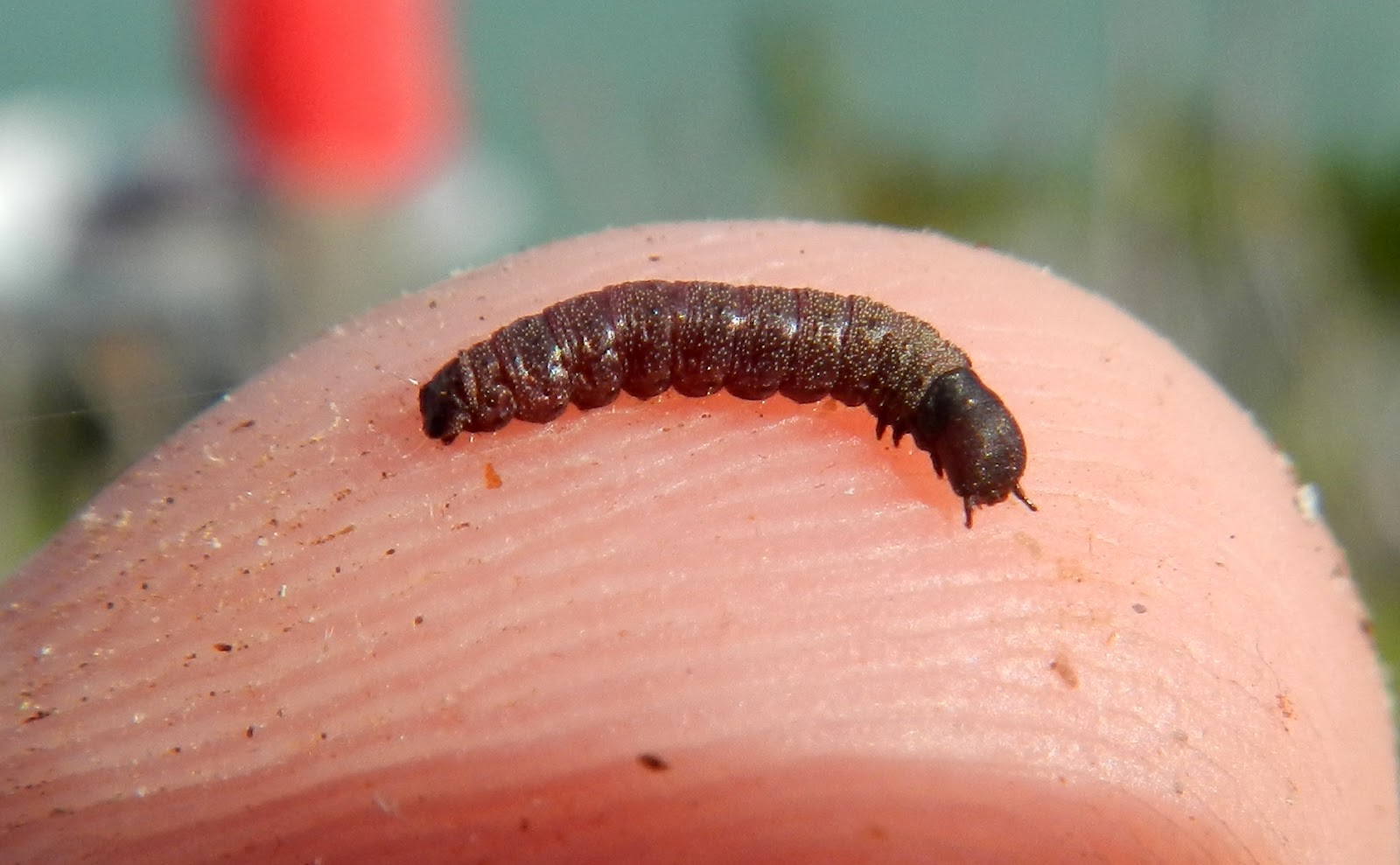
Inside some of these shelters (2/13), there was an odd larva, apparently a beetle larva, or so I initially thought. Because I am mostly a caterpillar person, I didn't really pay it much mind. 

A really terrible picture, but notice the "antennae". About 2-3 cm long. 

Louie, while processing insect samples one night, noticed that some things were not right about the apparent beetle larva - namely it had prolegs, the fleshy appendages that give caterpillars the appearance of having more than the six legs all insects have. I then looked at the "antennae" and found that they were not segmented, a dead giveaway that this was, in fact, a caterpillar and the "antennae" were actually tentacles (yes, that is the technical term for the fleshy projections that many caterpillars have - monarchs for instance).

Several of the shelters were torn like this, suggesting predation (by a bird [?]). This was the
only shelter with lines affixing it at the top - many had lower lines. 

I got much more interested after that, and sent along these pictures to Charley Eisemann, a good friend and probably the person on earth with the most knowledge about insect shelters. His blog - linked above - is simply phenomenal and if anyone was going to know the answer, he would. Very quickly (within a few minutes), he had correctly found the family of the moth - Mimallonidae. The amazing part here is that Charley has never seen a member of this family! Mimallonidae is an extremely small family by Lepidoptera standards, ~200 spp. - only 3 of which occur regularly in the US, a fourth is described from the US in Brownsville, TX, but is probably a tropical stray. He even dug pretty deep and found a very likely species identity, Ciccinus packardii - known from Cuba and known to feed on other Psidium species. While I do not know this for sure, it seems that is the most likely candidate as the larva matches very well the few images of Ciccinus online, and less so the other mimallonid genera. 

After a bit more searching, we came upon a young larvae feeding in a leaf press on P. longipes, which was not what I expected. This family is known as the "sack-bearers" and I was expecting something more along the lines of a bagworm (Psychidae), instead of a leaf presser.

A young (2nd, 3rd instar?) larva of this Ciccinus sp. ~ 8mm
Which brings us to the strange, pitcher plant-like shelters. The larva is oriented vertically inside the shelter, with a strange butt plate plugging up the bottom hole and the head just below the upper hole. What function the little hood forms is mysterious - perhaps shading the larva from the hot Bahamian sun or fierce rains? The better-known Ciccinus species of the US, C. melshiemeri, feeds on old oak leaves (too tannic for most caterpillars) and constructs a shelter, sort of like the pictured ones of frass pellets, silk and oak leaves in which it spends the winter as a larva, prior to pupation in the spring. This seems to be the case for this species as well - in two cases, I found spent pupal skins.

Spent pupal skin (successful emergence!) inside one of the shelters. You can also see the construction of silk and what
appears to be finely ground frass (caterpillar poop - a common building material for cats). 
Interestingly, I did find one that fit the description of the C. melshiemeri shelters well.

This was the only shelter anchored into leaves (it was vacant, unfortunately). You can see well the frass pellets forming the top of the shelter here.
The same shelter, with a Psidium leaf forming one side. 
These guys kept me occupied for quite awhile (I even dreamt about them!) and seem like a worthy avenue for future rearing efforts... there are a great deal of questions that remain about the shelters: Why the strange shape with a hood? Why build a free standing shelter, as opposed to anchoring it to a stem like most moths? Why wait around in a shelter instead of pupating right away? Do the shelters protect inhabitants from predators and parasitoids?


perhaps the prettiest of all found. I like the subtle banding.

Many thanks to Charley, Julia Blyth, John De Benedictus, Louie Yang, Jonah Piova-Scott and Jenn Mckenzie (who was the only one that could find occupied shelters) for help with the identification and finding of these guys.

Wednesday, December 4, 2013

Chenopod salt bladders

I recently published a paper on a cool plant defense system of certain plants in the Chenopodiaceae.

Three chenopod species at my field site (McLaughlin Reserve, Lake County, CA). In the center the whitish plant is Atriplex rosea, in the front and front left the dark green plant is Chenopodiastrum murale and in the back left the plant with triangular leaves is Atriplex prostrata. 
The chenopods are a diverse "family" (people can't really agree whether they are their own family or form a family with the amaranths) found worldwide. They tend to be common in three habitats, dry, salty shrublands, saltmarshes and recently disturbed areas (often roadside or agricultural). Two genera form most of the diversity and have many economically-important species in them. The first is Atriplex, the saltbushes (used to refer to perennial species) or oraches (used to refer to annual species).

A sea of Atriplex prostrata at McLaughlin. 

The second is Chenopodium, which includes the food species quinoa (C. quinoa) and lambs-quarters or pigweed (C. album).

Chenopodium neomexicanum, in the greenhouse

The coolest thing about these plants (and certain other chenopods - but not spinach or beets), in my opinion, is that they have these strange bladder cells on their leaf and stem surfaces. Several scientists have studied the salt sequestration of these bladder cells and found they are extremely important in ionic balance of the plant in saline environments. But many, if not most, of the bladdered chenopods are not halophytes (plants which live in salty areas). So what else are these good for?

The leaf of a cultivated variety of Chenopodium album. All the purple balls are salt bladders - the leaf surface below is green. 

I suspected, given their location on the plant surfaces, that they might be part of a defensive system of the plant, as they would be the first tissues contacted by herbivores and they would allow the plant to segregate defenses, which are often bad for the plant, away from photosynthetic tissues. So I tested the defensive function of these bladders by removing them from leaves and testing herbivore preference with a choice, assessing herbivore preference without a choice, and removing them in the field and assessing herbivory rates compared to control leaves.


Removed bladders from the C. album leaf above. The purple coloration is due to betalain, a compound shown in other studies of amaranths (closely related) to be an effective defense against insect herbivores. 

I found strong support for a defensive function for these structures. Plants have all sorts of cool structures (domatia, hairs, sticky glands, etc.) which are defensive in function and with this work, I added one more to this list. I'm working on a few further projects on chenopods now, I'll update with those when they get completed.

Reference: LoPresti, EL (2013) Chenopod salt bladders deter insect herbivores. Oecologia, DOI: 10.1007/s00442-013-2827-0