Pages

Monday, January 28, 2013

More on parasitoid nuptial gifts

I did a bit more poking around the literature (there is, fortunately, quite a lot on parasitoids) and found many other examples where some comparison was made between mated and virgin females. Every paper seemed to have different methodology and different measured metrics (related to whatever the paper was about).

A bad picture of a beautiful wasp, Mesostenus thoracicus, female, Walpole, Maine, 2009

The results of all these studies were not at all in agreemend. Some agreed with the findings in Bracon hancocki and found that virgins lived significantly shorter lives than mated females. Others found the exact opposite. Many showed that virgins lay fewer eggs or parasitize fewer hosts (independent of eggs, as in many cases more males can develop in a host than females), but others found the opposite result. Some showed that virgin females spent less time moving and ovipositing than mated females, which suggests they wait for mates. Others found no difference in similar metrics.

An unidentified Ichneumonid (Pimplinae?) ovipositing into a Herpetogramma thesausalis pupa, Maine, 2009

Perhaps the most interesting result was that of Sagarra et al (2002) who found that female Anagyrus kamali did not differ in longevity based on mating status, but males did. Unmated males lived 40% longer than mated males and females required more than one mating to get sufficient sperm to fertilize all their eggs (some scientists believe this is rare in parasitoids, others don't - I don't have an opinion). This does suggest that males put some serious investment into their sperm, as all other conditions were equal for these males.

Bob Carlson, one of the most knowledgeable Ichneumonid specialists around, said: "There are so many kinds of parasitoid Hymenoptera, that I expect it certain that some of them have evolved such that females get sustenance from male seminal fluid. "

That seems pretty reasonable to me, though it might be a needle in a haystack search for it. Anyone interested in the references I have compiled on this or a longer summary of each paper's finding, let me know. 

This Ichneumon (Ichneumoninae, I believe) is a rare parasitoid of  Herpetogramma thesausalis. This male was
buzzing around a patch of sensitive fern with lots of host shelters, likely mate-searching.


Thursday, January 10, 2013

Parasitoid nuptial gifts?

A Braconid, Alabagrus texanus, a male. I doubt any nuptial gifts are given in this species scramble-mating system. 

I found something yesterday that I think is really-cool. While browsing old copies of the journal Bulletin of Entomological Research, I stumbled across this quote, in reference to Bracon sp. (probably hancocki).

"Average life-span for mated females was 13.6 days, whereas virgin females lived for an average of 5.6 days."

Here's the catch: parasitoids are unreported (at least that I could find) to give "nuptial gifts" i.e. a resource given by male to female during courtship or copulation. Charles Godfray, in his book (bible), Parasitoids: Behavioral and Evolutionary Ecology, says "I know of no evidence of nutrient transfer during mating in parasitoids". Many other insects are known to (katydids, certain flies, etc.). This quote makes it seem like there could be some transfer of nutrients in the sperm (as the authors made no mention of courtship behavior).

Making the story more interesting, and believable, the authors state that the females copulated many times with the same male upon emergence, then began egg-laying a few days later. Multiple matings are rare in parasitoids, another indication that the female is likely gaining something else besides just sperm from the male.

An interesting observation, and one that probably could be examined, as Bracon is a fairly common genus.

Reference: Olaifa, J. I., & Akingbohungbe, A. E. (1982). Bionomics of Bracon ?hancocki (Wilkinson)(Hymenoptera: Braconidae), a Larval Parasite of Cydia Ptychora (Meyrick)(Lepidoptera: Tortricidae) in Nigeria. Bulletin of Entomological Research, 72(04), 567-572.

Godfray, HC. (1994) Parasitoids: Behavioral and evolutionary ecology. Princeton University Press. 

This is the same species in the photo above emerging from a Herpetogramma caterpillar, prior
to spinning its cocoon. 

Tuesday, June 26, 2012

A troubling news story

This is the first, and possibly last, political item I will post on this blog - but I feel as if I have good reason to. Read this story. As a concerned citizen, biologist and supporter of science in general, I cannot believe that this would occur - and as a proud Brown biology department alumni, I am saddened that a fellow Brown biology major (Bobby Jindal) would facilitate this nonsense.

Blow this picture up and look at the bill on this juvenile Snail Kite - perfectly evolved to eat large snails. 

I see two problems with this:

1) Obviously evolution is being horribly misconstrued, though perhaps it is heartening to hear that the books claim the Loch Ness monster is real, if that is the best anti-evolution defense they can come up with, they cannot expect to be believed wholeheartedly (perhaps). If we wish to continue to advance as a society, we need scientists working on biological questions (among all the sciences, clearly). As evolution is the backbone of biology and has informed our profitable (not monetarily, perhaps) research into human health issues as well as conservation/environmental science issues, we need to acknowledge its existence.

2) Science in general is being cast doubt upon. The credibility of evolutionary biologists/climate geologists/etc have been questioned publically by (imbecile) politicians without a firm grasp of the science, simply with a political agenda. While this is ridiculed and many of the arguments downright laughable, it is giving the public a perception that scientists perhaps are not to be trusted and their findings not true. To continue to advance and learn (I would argue a necessary part of any society) we need incorporate science better: fund it better, apply the findings in all fields, and simply understand it better (teach it better). The Louisiana system here is a regression to the middle ages. 

I wrote this in haste, perhaps it is a bit digressive and certainly a bit of a rant, but it should be brought to attention of more (as I know this blog has at least 4 people that read it!). 

Monday, June 25, 2012

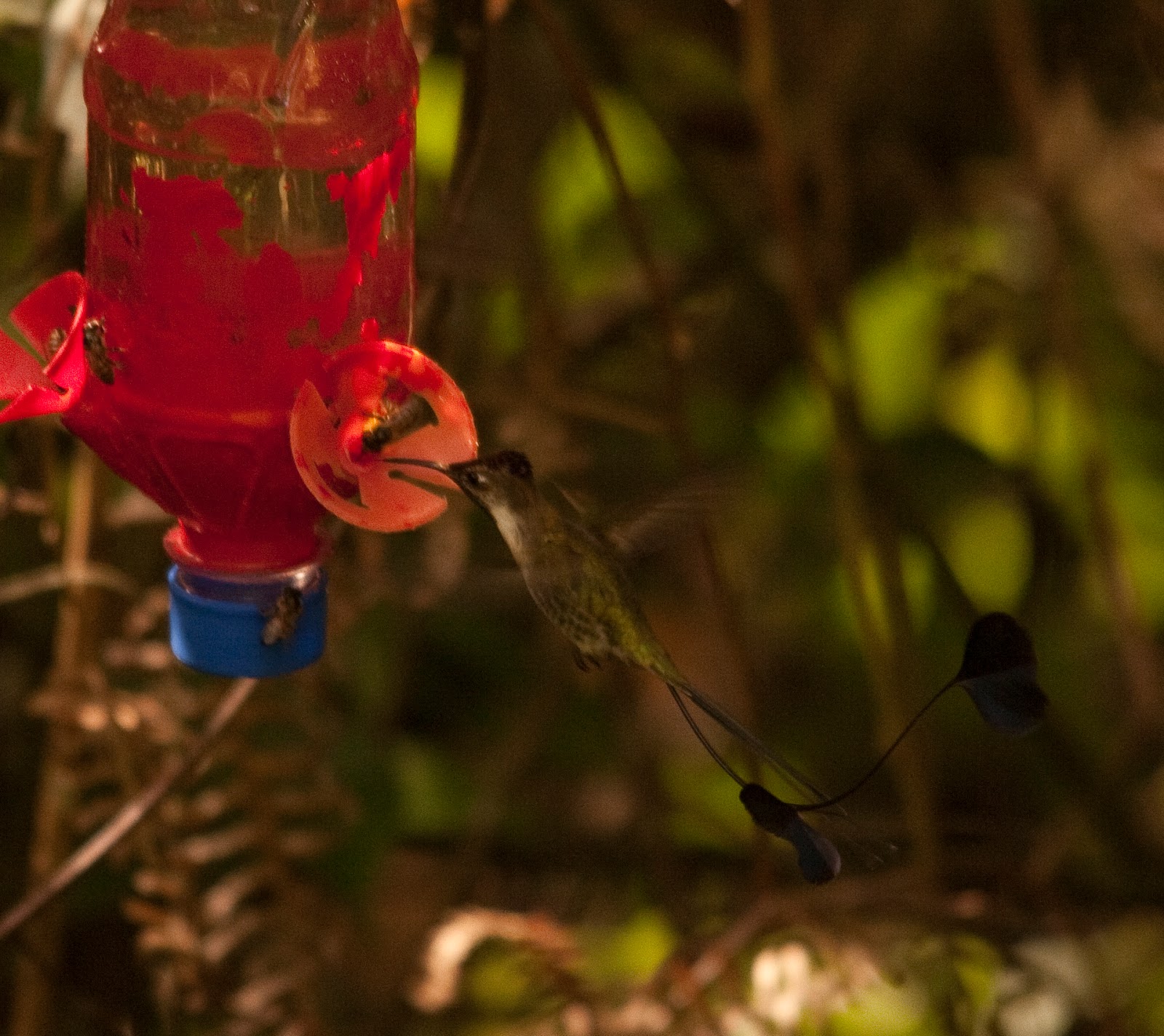
Peruvian Hummingbirds

I have been remiss in updating this, and have only a few moments, so just pictures... During the month of May I saw 48 species of hummingbirds, a few of which are below. See how many you can name...


The rarest hummingbird in the world?


A bad picture - but does it matter?


Jimmy's favorite humminbird, I think. 


Monday, June 4, 2012

Nantucket Barn Owls

Julia, upon getting back from New Zealand, went back to Nantucket to continue studying the Barn Owl population there - the largest population in MA (it is a state-listed species) and one of the most northern in the United States (maybe the world!). Perhaps unsurprisingly for a species at its northern extent, they are going great guns after the really mild winter - she has found over 60 chicks this year thus far, a number way above all other years.

An older chick awaiting banding - from the 2011 season.
She put a camera in one of the nestboxes this year and compiled many of the "highlights" of the first bit of the season into a video:


Delicious, aye? Crazy to think that they swallow almost all their prey whole - how lucky we are to have teeth! (not to mention utensils).

Another baby of the 2011 season, a little younger.