Pages

Tuesday, June 26, 2012

A troubling news story

This is the first, and possibly last, political item I will post on this blog - but I feel as if I have good reason to. Read this story. As a concerned citizen, biologist and supporter of science in general, I cannot believe that this would occur - and as a proud Brown biology department alumni, I am saddened that a fellow Brown biology major (Bobby Jindal) would facilitate this nonsense.

Blow this picture up and look at the bill on this juvenile Snail Kite - perfectly evolved to eat large snails. 

I see two problems with this:

1) Obviously evolution is being horribly misconstrued, though perhaps it is heartening to hear that the books claim the Loch Ness monster is real, if that is the best anti-evolution defense they can come up with, they cannot expect to be believed wholeheartedly (perhaps). If we wish to continue to advance as a society, we need scientists working on biological questions (among all the sciences, clearly). As evolution is the backbone of biology and has informed our profitable (not monetarily, perhaps) research into human health issues as well as conservation/environmental science issues, we need to acknowledge its existence.

2) Science in general is being cast doubt upon. The credibility of evolutionary biologists/climate geologists/etc have been questioned publically by (imbecile) politicians without a firm grasp of the science, simply with a political agenda. While this is ridiculed and many of the arguments downright laughable, it is giving the public a perception that scientists perhaps are not to be trusted and their findings not true. To continue to advance and learn (I would argue a necessary part of any society) we need incorporate science better: fund it better, apply the findings in all fields, and simply understand it better (teach it better). The Louisiana system here is a regression to the middle ages. 

I wrote this in haste, perhaps it is a bit digressive and certainly a bit of a rant, but it should be brought to attention of more (as I know this blog has at least 4 people that read it!). 

Monday, June 25, 2012

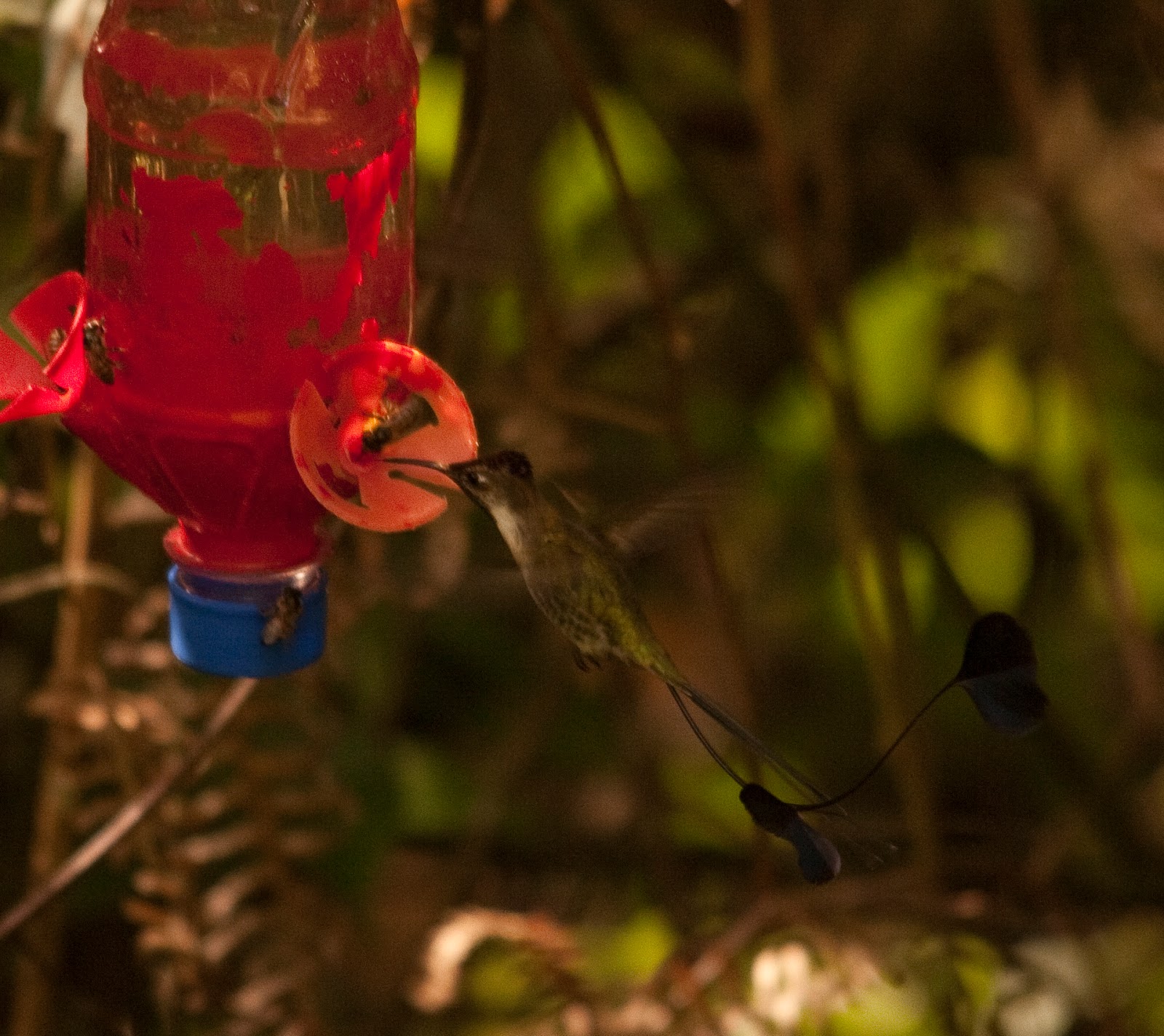
Peruvian Hummingbirds

I have been remiss in updating this, and have only a few moments, so just pictures... During the month of May I saw 48 species of hummingbirds, a few of which are below. See how many you can name...


The rarest hummingbird in the world?


A bad picture - but does it matter?


Jimmy's favorite humminbird, I think. 


Monday, June 4, 2012

Nantucket Barn Owls

Julia, upon getting back from New Zealand, went back to Nantucket to continue studying the Barn Owl population there - the largest population in MA (it is a state-listed species) and one of the most northern in the United States (maybe the world!). Perhaps unsurprisingly for a species at its northern extent, they are going great guns after the really mild winter - she has found over 60 chicks this year thus far, a number way above all other years.

An older chick awaiting banding - from the 2011 season.
She put a camera in one of the nestboxes this year and compiled many of the "highlights" of the first bit of the season into a video:


Delicious, aye? Crazy to think that they swallow almost all their prey whole - how lucky we are to have teeth! (not to mention utensils).

Another baby of the 2011 season, a little younger.

Tuesday, May 29, 2012

Birding Lambayeque: Algorrobo, Salas

This is the third site in Lambayeque that demands a visit - this site is quite less accessible and takes more time than the other sites, but holds the potential for some REALLY cool birds (White-winged Guan, for instance).

Gray-chinned Hermit, Porculla race, 3-May-12
I found this site by stabbing fairly at random in the hills around Salas and the two small towns of Algorrobo and Sauce. The hills around Sauce were very degraded and while they held interesting birds (Black-and-white Tanager, etc.), there were surely better places nearby. And at last, an older man in Algorrobo explained that farther out from Algorrobo along a few trails there were nearly untouched forests, which one would have to travel far from Sauce or Salas to find.

Ecuadorian Trogon, young male, 30-Apr-12

After a few stabs at finding the right trail, Juan Molina and I think we have happened upon what might be the best trail up to see the specialties here: Henna-hooded Foliage Gleaner, Guayaquil Woodpecker, Piura Chat-tyrant, Long-billed Starthroat, Ecuadorian Trogon, Whooping Motmot, Gray-chinned Hermit, Gray-and-gold Warbler, Speckle-breasted Wren, Ochre-bellied Dove, Thick-billed Euphonia and more. To get to this trail, find your way into Salas and hire a driver to take you up to Algorrobo, which is another 3k or so up the road. At the first set of houses in Agorrobo, you will see a path leading between them to the left. Walk on this path for about 45min-1hour until you see a house adjacent to the path on your right. Then continue on a little bit farther - you will see a well made fence on your left. Up ahead will be a house with a tall antennae.

This is the fence you are looking for. The house is obscured by the trees on the left in this picture.

When you can see this house - but 50-100m before - take a right on a smaller trail towards the hills. This will lead you quickly up to a clear area between two houses. Go straight between them and begin climbing the hill - a small river/stream will be in a little valley on your left.

Terrible picture of a Whooping Motmot, 30-Apr-12
Before long, you will reach an area strewn with large boulders. This seems to be the easiest spot to find the motmots, plus there are tons of bats in the boulders, which is cool to watch. You will begin climbing again after this and you may notice some PVC tubes bringing water down to the settlement. The path will split here and you have a choice. The left trail is short, but has the hermit and motmots on it, as well as this strange immature thrush - which I suspect is Glossy-black, but I have no experience with the species at all and worry that I might mix it up with Pale-eyed or maybe Slaty.

Thoughts? 
If you have the time, choose the path to the right, which winds uphill past some grazing land before it dives back towards the stream.

Pass this shed and you will find yourself in wonderful forest.

After this, you will find yourself in another zone completely - huge fig and other trees tower over the forest and it looks unlike any forest I have ever seen before. In here you will start seeing/hearing new species: Black-and-white Becard, Red-eyed Vireo, Pacific Elaenia, Speckle-breasted Wren, Gray-and-gold Warbler, etc. We found this becard down the path and initially IDed it as Slaty, as it looked much lighter and you could see a faint light mark above the base of the bill - and it responded to a Slaty song. Looking at it now though it seems too plump and large-billed for Slaty... is this a One-colored?

Becard sp., 30-Apr-12

At a certain point, you will cross a stream and the path will weave to the left of the stream for awhile, then turn and go uphill. The uphill trail peters out to nothing (bring a machete), but walking along the stream is productive and eventually ends you at a beautiful little waterfall and pool full of cool water and looking perfectly like it is taken from a visit Belize commercial. Strangely, the pool had a pair of Black Phoebes - these are certainly not resident here in dry forests.

Two of your authors cool off in the middle of the day. 

What other species might this location hold? For one, the hills here are known to hold both White-winged and Bearded Guan and locals speak of seeing White-winged fairly frequently. While we have only found Three-banded Warblers (well, 1) near Sauce, they ought to be here as well. Other birds known from El Limon, in Piura outside of Olmos may be here as well - Laughing Falcon, Pale-browed Tinamou, Solitary Eagle, several swifts (along the rock faces on the left side of the Quedrada), Ecuadorian Piculet, etc...

Lunch time break. 3-May-12
If you find any of these - report them to eBird - a growing reference of the birds present now can be used in the short-term to compare changes in range with El Nino and La Nina and longer-term to show range and population trends due to human development or long-term climatic changes.

Long-billed Starthroat. I watched this bird fly in and then the bird sat obligingly for 15 minutes while I managed to point out the unmoving hummingbird in the dense tree 30 meters away to everyone else. 

Birding in Lambayeque: Cerro Chalpon, Great Inca-finch


The second in my series of site descriptions: Cerro Chalpon and the big surprise of Great Inca-finch in Lambayeque. On April 9th, 2011, Andre Burnier and I set out from Motupe to see what the giant hill north of town was like. We walked all the way from Motupe (~5km), but it is far easier to get a collectivo/moto from the town – they leave next to the cars to Olmos about a block from the market. The location you want to go to is Zapote (which is the name of a native fruit in the genus Capparis). When you arrive you will be met with a very long staircase… filled with vendors of religious paraphernalia.

The first Great Inca-finch found in Lambayeque, 9-Apr-11

On this first visit, we had no idea what this was about, but I will fill you in. The most sacred site in Lambayeque is a shrine located about halfway up this hill, where villagers found a tree in the shape of a cross (clearly divine intervention in tree growth, right?). Several years later, the tree was stolen! After it was recovered, they made the site a guarded sanctuary (open 7-6 daily, if I recall correctly). The peregrination of climbing these steps is made by thousands every year, young and old. And preyed upon by hundreds of vendors selling items from chicha to photographs with llamas to rosary beads and baths in the “sacred” water coming down the hill. You ought to hike up the first bit without birding, simply to get beyond the headache of the town of Zapote.

Tropical (Tumbes) Pewees are very easy to find here and often very obliging
Once it starts to open up, put your ears to work – listen especially for Elegant Crescentchest, Tropical (Tumbes) Pewee, Dusky-capped Flycatcher, Andean Tinamou, Black-and-white Becard, and enigmatically, Ash-breasted Sierra-finch – a bird which Fernando and I know of few other records in Lambayeque, but is common here, especially higher. Keep you eyes out for raptors: Black-chested Buzzard-eagles, Variable Hawks and Peregrine Falcons are fairly common and the only Aplomado Falcon I have ever seen in Lambayeque was near this hill.

Great Inca-finch, Incaspiza pulchra, 13-March-12

As you climb, you will notice the vegetation getting sparser and more rocky, eventually you will reach a vertical rock face with lots of bromeliads. This is where to begin looking for the Inca-finch as well as White-headed Brush-finch (I found two nests in epiphytes), Ash-breasted Sierra-finch and with some luck, Tumbes Hummingbird. You will reach the official sanctuary, with a metal gate and some really garish yellow stairs. It was on these stairs that I saw the finch the first time, picking at crumbs. The second time, we located it above the actual cross, another few flights of stairs higher. Note that at the cross, you need to be respectful of the pilgrims (don’t go on a weekend!), and technically photography is not allowed – but the guard lets us take pictures of the birds.

The crazy staircase that you must climb to get to the top (of the trail, not the hill).
They leave the lights on here all night, which attracts tons of moths, leading to some very fat and happy pewees, which are practically tame. Also in the mix up here are the tamest Baird’s Flycatchers I have ever seen. From this spot, you can ask the guard if he has seen the bird with the yellow legs and the yellow beak or just wait. Keep your eyes on the skies, too: a condor nest was found on this hill in the nineties, though the older guard when asked remembers only seeing a condor once here. 

As I said, the Pewees are obliging.
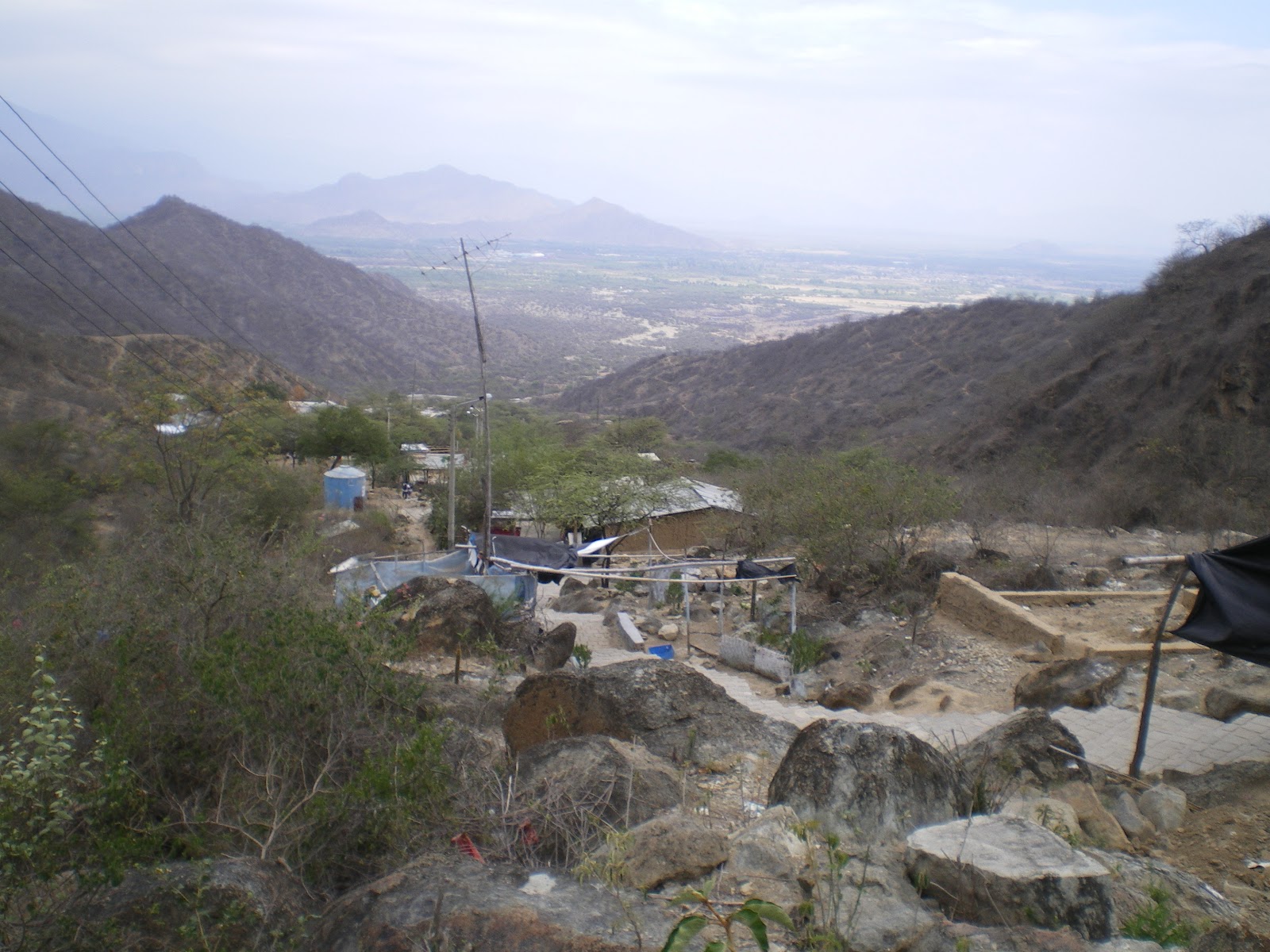
The view from the trail. Vendors on both sides and just obscured by the hill on the right is the city of Motupe.

The vendors in this section deal in holy water that washes down the hill. Don't drink it.