Pages

Sunday, August 9, 2015

Oops, my field site disappeared: lessons learned from the Rocky Fire

Last week, on the 29th, I was coming back in after a day in the field at the UC-Davis McLaughlin Reserve (in Lake County, CA) where I do all my work. I was setting up some insects in containers in the building when some one from next door came over to point out a smoke plume rising NW of the reserve.

I wonder if this is the first photo of the Rocky Fire... it was taken at either 4:01 PM, Cal Fire says it started at 3:29, a few miles NW of the reserve. 
Within a few minutes, it was obvious that this wasn't going to be like the other, smaller fires that were put out quickly the week before in the same area. I continued doing my work and made dinner. I wasn't particularly concerned, since the wind was pushing towards the fire and the plume was making its way away. By nightfall, it got worse, and the wind began to shift.

7:57 PM and the smoke plume still moving away from us.  
At this time, I went next door to the mining building to hang out with the safety guy there, who was on site in case this caused any problems for them. By 10ish, the power had gone out, the wind had come around and there was smoke and a small amount of ash falling. By 11, CalFire had shown up and told us it had jumped the road and that we were going to be evacuated soon. I packed up a few clothes, my bug nets, computer and a little bit of food and was on the road by midnight and back in Davis a little before 3 AM (nearly hitting a deer in the process). I fully expected to be back in a day or two. I had planned to stay there for a couple weeks - my longest continuous trip of the summer - as both the tarweeds and the columbines are in the middle of their season in late July/early August.

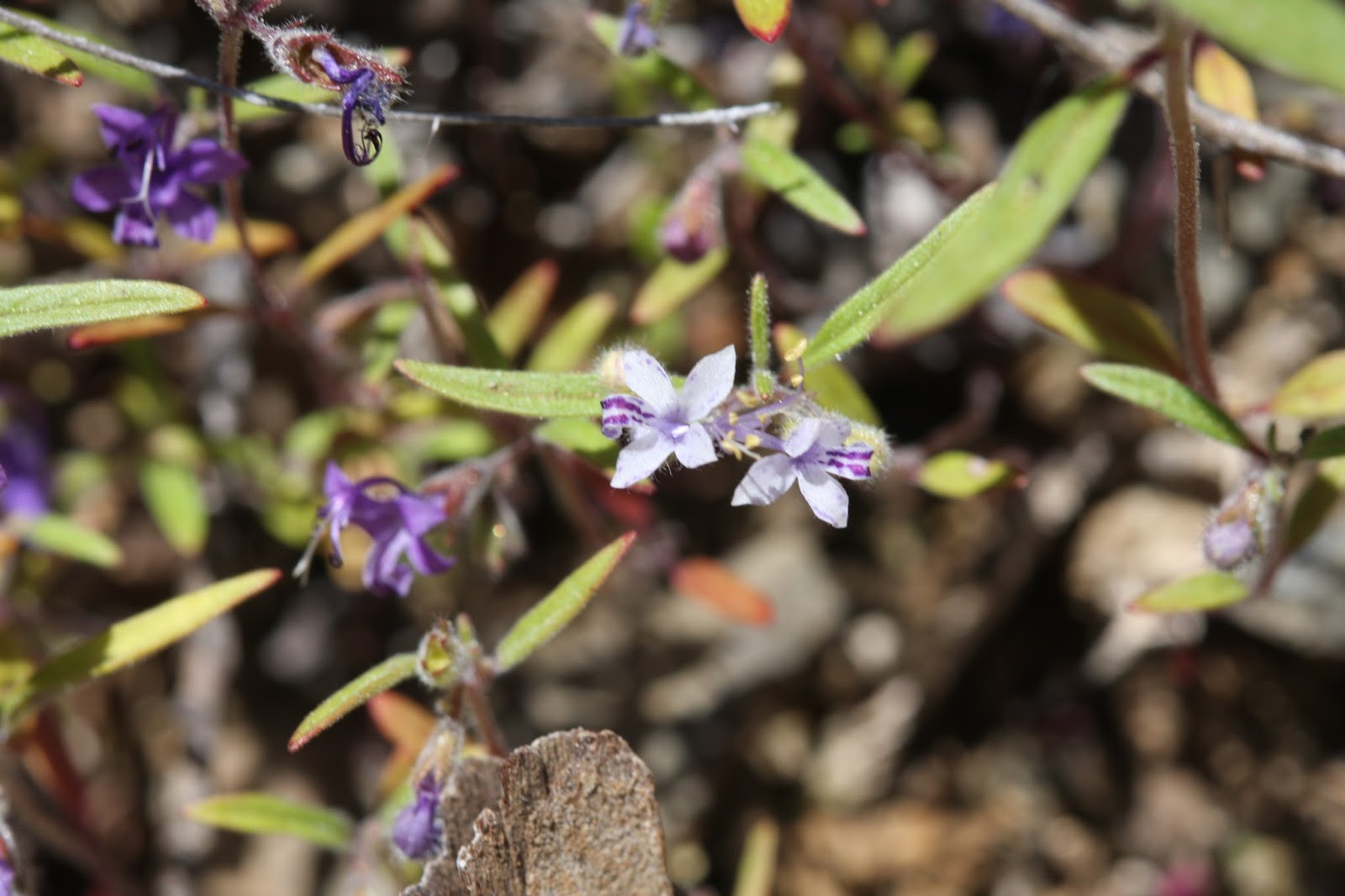
Navarretia mellita, the subject of one of my experiments, which was going along swimmingly before I left. 
After the evacuation and my near deer miss, I was running on a bit of adrenaline... I got to sleep by 4 AM or so and was up again by seven. And I spent the better part of the following week that I was evacuated refreshing the CalFire website as the fire grew in waves until nearly 70,000 acres (that is ~110 square miles). My sites all lay pretty much on the fire perimeter - I had no idea what to expect until I got back, as I knew that fires burned patchily.

Doing small-scale insect-plant interactions, I do my experiments on a plant-scale - manipulating traits of one plant, and I mostly work on annuals and all on a yearly basis (which means I can't do a pre-/post-fire comparison). I do many experiments each season - this year I was running 7 at the time of the fire - all in the northern and western parts of the reserve, where the fire was most intense. So my heart was racing the whole trip back, when I was allowed in on Thursday (the 6th - over a week after evacuation). I dropped some refrigerated stuff off and quickly hurried out to my sites...

This is the wet meadow where my recently published experiment took place and where I had another experiment going this year. 
As I drove in to my columbine experiment, I knew it wasn't going to be a pretty sight. You can still see a streambed on the left side. Surrounding it was a nice population of serpentine columbine (Aquilegia eximia), hedge-nettle (Stachys albens) and common monkeyflower (Mimulus guttatus) with a scattered coffeeberrry (Rhamnus sp.) and willow (Salix sp.), bordered by THICK chaparral (manzanitas, oaks, chamise, etc.). I did find remnants of the experiment...

I should have bought the pin flags rated for raging-wildfire temperatures. Next time. 
My next experiment was through a tiny circuitous trail which I had carefully machete hacked earlier in the season through manzanita and cypress. It involved going over and under a number of logs and around small breaks in the chaparral. Yesterday I could walk (and see) in a straight line through a whole lot of nothing. All I found was a tiny bit of melted flagging tape, attached to a columbine stalk that had somehow escaped total incineration...

Based on its location (and most of my landmark shrubs were gone), I think this was control #50. It formerly was under a manzanita. I found it in the middle of a large, barren field.  

All was not lost, however! My next project was a huge set of experiments examining defensive induction in a tarweed, Hemizonia congesta (this specific epitaph is accurate, at least for me). Fire fighters had made a dozer line through the upper end of this field between two roads. The flames reached the two roads and the firebreak, but fortunately never jumped and my site (containing 250 plants which I had been following for months), ~200 meters beyond, remained intact. I was a bit worried that perhaps the insects would have been affected, but the insect communities seemed normal in abundance and identity.

My site is on the middle hump in the mid-ground. You can see the sparse vegetation on those serpentine barrens compared to the field of Avena in the non-serpentine areas. 
The grasslands were wild to walk around. Grass fires don't burn as hot nor for as long as chaparral fires, so some things survived. Not among those surviving were the rabbit-poop looking burnt star thistle flowers and fruit.
 
It burned the spines right off the thistle flowers. And it looked like most hadn't seeded... hooray!
The living stuff on the right is a variety of tarweeds (Hemizonia, Holocarpha and Calycedinia spp.) growing on a serpentine barren (low biomass). The burned area on the left was Avena and star thistle and had much higher biomass and apparently burns better. 
Like the wicked witch of the west when confronted with water, milkweeds (this is Asclepias eriocarpa) apparently just melt in the face of fire. 

Not all the milkeeds melted, fortunately for this large monarch caterpillar (and the orange oleander aphids out of focus in the foreground). There were a bunch on a small surviving patch of Asclepias fascicularis which was no more than 2 meters from completely scorched earth. I wonder whether they emigrated here from melted plants or if they were all on the one patch to begin with.
The grassy areas had tons of Mourning Doves. More than I've ever seen at one time in my life. Did they group up after the fire and emigrate right to my field site? I don't have a clue. I usually see them near Croton (Eremocarpus) setigerus, but that's not around this site - I wonder if they were eating burned thistle heads or other seeds exposed by the burning of all the grass.

The patchiness of the fire on a microscale was crazy. Here a small patch of seeding Mimulus nudatus (a rare California endemic found only in serpentine soils in a small part of the northern coast range) stands amidst a scorched landscape. 
Another set of experiments I had were also very close to a burned area, but they too, were spared. I was studying the ecology of two sticky species: Navarretia mellita and Madia elegans. Both are weedy species that love disturbance. There is an old road above the center that is drive-able, but rarely driven and hosts nice populations of both species that like the roadside disturbance. The Navarretia experiment was pretty much fine, being about 5 yards from the road. In the couple weeks that I hadn't checked it, some of the seeds had dehisced, but I had final inflorescence number for all the plants, which is enough of a fitness proxy for my purposes.

Big flags, little tiny plants.
The tarweed (Madia elegans), on the other hand, suffered a little bit. During the fire, trucks must have driven by that site hundreds and hundreds of times... I was there for the afternoon yesterday and had 4 or 5 cars drive by twice each (it is a dead-end) - and that was long after the fire was out in that section. Tarweeds are sticky and I was manipulating the amount of insects they caught (following up on Billy and Ian's Madia study and my columbine study). Most of the plants were within a yard of the road edge (non were on the road - none got hit), but with the hundreds of vehicle passes the amount of dirt kicked up and subsequently caught by the tarweeds was crazy. The treatments - varying amounts of dead fruit flies - were sort-of intact, but redoing the treatments was a major trial, as the fruit flies wouldn't stick. This will get better as they grow and they ought to flower for another month or so, so perhaps this won't be a complete wash... we'll see.

Its hard to see in this picture, but pretty much every glandular trichome on the plant had dust stuck to it, rendering it pretty much completely unsticky. 
The last experiment, a manzanita fruit manipulation, had pretty much been doomed from the get-go. I started the experiment early in the season, when the plants thought they had lots of water, but soon after, they aborted all the fruit I had in the experiment. So I moved to a new site, on the edge of a pond, where the shrubs were a little bit happier, but I started it too late (as I was still nursing the first try along a little bit). The fire left only one of those manzanitas standing at all as it whipped around the pond. Not a huge loss, though it would have been nice to get the last set of data.

A dead deer in the pond that the manzanitas were next to. I don't know for sure that this was fire related, but it seems likely as the chaparral up to this pond on three sides was burned completely for hundreds and hundreds of meters. 
 In the pond, besides the dead deer pictured above, life seemed to go on fine. The tule and cattails were intact, as good, water-filled greenery should be. Pied-billed grebes continued to feed streaky little babies and coot made all their funny noises. I finally saw the first Ruddy Duck baby of the year - in years past there have been quite a few in this pond and this year there were quite a few pairs, but only one duckling seems to have come out. A Gadwall nest that I found a few weeks back should have hatched (or been preyed upon by coyotes, raccoons, etc., by now) and a few rather large babies were around the pond, along with the first Green-winged Teal of the season. Tiger beetles ran on the shores and dragonflies flitted by, as if nothing had happened.

I'm not sure where this jackrabbit fled during the fire, but he's a survivor for sure - there wasn't much unparched in the area that I found him. There were a good number of these around - and strikingly, in a lone patch of Garrya, with literally nothing for hundreds of yards around, a chipmunk scolded me!
Other folks lost experiments as well. This was a bird exclosure, under which was a chamise that had been monitored for years. 
The amount of life around, even in burned areas just a week later was astounding. While exploring, I heard a pair of Rufous-Crowned Sparrows chipping from a couple mostly demolished manzanitas along a completely devegetated streambed. They popped out to check me out - I suspect that most territorial animals are dealing with a lot of stragglers coming by. I had a secondhand report of a mountain lion wandering down a road near fire crews in the middle of the day - not a typical behavior. While watching sandpipers, I heard a barking, like that of a large dog coming from near where my truck was parked. Thinking it might be a lost dog displaced by the fire, I headed towards it. As I neared the truck, on a rock above it was a coyote, looking down at me and barking like hell. As I fumbled in my backpack for my camera, he ducked behind the rock and continued berating me until I left.

Walking through dense manzanita chaparral is miserable. Walking through the same area now is quite easy.

Though it makes you quite dirty. This was after only about 10 minutes. After an afternoon of hiking around, I looked like a coal miner.
For a number of reasons, I spend a bit of time looking at spiders: they are important predators on many plants, I've worked on crab spider behavior, and much of the Bahamian island research revolves around them. One of the first signs of life in the fire area was funnel web spider (Agelenidae) webs, which are a thick mat of webbing with hole the size of a nickel or so (like a funnel, as the name suggests). There were tons of them on top of the blacked dirt and vegetation.

A nice clean, fresh, funnel web on top of blackened soil. 
In contrast, in non-burned areas, the webs were messy with ash that was clearly flying in large quantities with the fire nearby. I wondered why the spiders hadn't spun a new web or cleaned it out. I suspect that the reason has to do with how costly spider silk is to the spider. Being made of protein and laid out carefully, it is both nutritionally costly and time-intensive to make a web. Many spiders eat their webs if they take them down and there is even a group of parasitic spiders which eat the webs that other spiders make (!!!).

A web with lots of entrapped ash. I think it is a theridiid, but I didn't look too closely. All the webs were covered like this.
Pocket gophers also survived, with fresh diggings in the 5 or so days since the fire passed through this area. I just saw my first pocket gopher a few weeks ago, while being acquainted with their diggings for years. They have really, really weird ears.

Its been a really interesting time to look at the natural history of this area. The next few years, while I continue my phd, will also be an interesting time of watching fire-following plants, resprouters and who knows what else.

The fire opened up previously hidden scenes from dense chaparral, like this midden. I guess this was from when there was a nearby shale quarry operating, but I'm not sure. Those beer cans look old...
AND THEN...

I wrote most of this the night of 8/8/15. About 4 PM today (8/9/15), another call came on the radio about a smoke plume. I hurried outside and shit... another BIG fire, within a couple miles, this time SW of the station. This one has been termed the Jerusalem fire. I hurried and collected some seeds for a friend and reconned some badly dozered sections in the SE portion of the reserve.

Jerusalem fire, ~4:30 PM, 8/9/15. If the twittosphere is to be believed, those two plumes are from two separate arson fires.
These dozer lines are ridiculous. There are at least 4  (and a road) between this particular one and anywhere the Rocky fire actually burned. They tore the shit out of some really nice oak woodland habitat and compacted soil, etc. 
Fire haze does produce extremely beautiful light.

This charred live oak (?) leaf was one of many which rained down during my hike... the fire was 3-5 miles away at this point.

Like ecologists, firefighters seem to like to put flagging tape on anything interesting. Here on abandoned machinery. Its also on gates, fences, various poles, etc. 

A constant part of the wildlife now, these big birds are really thirsty, sometimes drinking 3,000 gallons every few minutes. I'm getting better at my identification of these. I think this is a Boeing 234 "Chinook", but these two rotor helicopters seem almost as confusing as empid flycatchers... field guide.here. 
We'll see how this one pans out... I'm not particularly worried for my experiments now. If they burn, they burn but there is a lot of burned area between this one and them (it is continuous, but the fire would need to turn a couple different ways before it got to anything).

The pond this CH-47 just refilled from is part of the complex where the field component of this paper took place. 

I did learn some field season lessons, as well.

Things I will do differently next summer:

1) Space my experiments out farther! The farther apart they are, the more likely a fire line will go between them in case something like this happens again.
2) Put them a little farther back from roads (this also would protect against accidental drive-overs).
3) Put them in a matrix of previously burned areas. Its hard to reburn the same areas two years in a row (though the Wragg fire managed that this year in Yolo/Solano counties!). That will allow a little extra safety.

And finally - while I lost some work (a couple months on a couple projects), I'll certainly be able to repeat those next year and I'll get a couple completed experiments from the seaon. Thankfully, I didn't lose my house, my pets, my vehicles or my livelihood - others did.

A lone manzanita looks out over a burned land. The road you can see in the back right is Roundtop road, in Knoxville Recreation area. It would be a good place to check this out from (but do not, under any circumstances, camp in the campground there). I guess the area to the right all has already/will burn in the Jerusalem fire, too. 

Wednesday, July 22, 2015

Sticky plant attraction, a new paper

I could not possibly do as good a job as the summary of this paper written by Elizabeth Preston, here, so I'll first tell the backstory - and when it comes out, I'll detail another cool part of it (which is not in the preprint version - instead buried in the appendices).

Heliothis phloxiphaga eating a flower bud of Aquilegia eximia, the serpentine or sticky columbine. Lake County, CA. 
Last summer, I spent most of my time studying Trichostema laxum, which I've written about in a previous post. I was trying to test my hypothesis that external chemical defenses are easily washed away by rain (which may be driving the pattern that few are found in wet areas) and spent countless hours doing various pieces of this - observing pollinators (the volatiles washed off might affect pollination positively or negatively), counting insects, leaves, buds, flowers and seeds (which can be done in situ!) and by July, the drought and some jackrabbits made this experiment look rather grim. I still haven't brought myself to analyze these data, as it ended so depressingly...

As the floral color polymorphism was not in the experimental population, I didn't notice it until the end of the summer, and gathered some, but not enough, data on it. Lake County, CA. 
I was getting a little frustrated and I wandered around, naturalizing, which is always a remedy for frustration (to me at least). I came upon a columbine - Aquilegia eximia - which I instantly knew held some potential for cool experiments. The first thing I noticed was that it was extremely sticky and covered in dead insects and the second was that it had a bunch of predators on it. I immediately thought to Billy Krimmel and Ian Pearse's cool paper on tarweeds (doi:10.1111/ele.12032) , in which they demonstrated that the dead insects provided food for predators, which protected the plant from herbivores. I figured initially that I would simply test this in another system.

A Hoplinus nymph (probably the most important predator in the system) approaches an
entrapped fly.
Because I was out in the field without access to a genetics lab to get dead flies, I couldn't replicate their design - where they added dead fruit flies to plants to supplement carrion - so instead I removed all the carrion from half of my 50 plants, hypothesizing that I would get a decrease in predators and an increase in herbivory (which we did!). I also thought hard about what else to test to add to Billy and Ian's work. I thought that, perhaps, it would be interesting to test whether the plants attracted the various entrapped insects (mostly small flies, wasps and beetles) somehow. Lots of plants attract insects - pollinators are the most obvious, but volatile signals attract predators, other herbivores and even birds (doi: 10.1111/ele.12177). Having petri dishes, plastic mesh and tanglefoot in my field kit - I made little sticky traps, with a sticky mesh top and a petri dish bottom and I put either columbine stems and leaves (a very small amount) or nothing in them. Collecting them 24 hours later, I found that the dishes with columbine had higher insects than the empty ones (which would demonstrate the ambient rate of insects landing on these traps). The trapped insects were also little flies, wasps and beetles, just like on the plants themselves.

Dead Hymenoptera on columbine (I may be giving up entomologist credentials, but I am not sure whether it is a wasp or an ant alate).

So this became a story - perhaps logically - that the plants were somehow attracting insects to kill and feed to the beneficial predators on their surfaces (retaining their services). I presented this work in a talk at a little student conference at Davis during recruitment weekend and played with several ways to frame the story. The first was to be rather dry - columbines attract insects and control a tritrophic defense (or something along those lines). Instead, I thought long and hard about trying to make a metaphor (socialism - a worker's paradise for the predatory bugs or a Roman bread and circus type thing, but they didn't really work) and while I don't remember how I came up with this - I settled on the sirens, figures of classical mythology who lured sailors to their deaths. I therefore framed it as these poor insects - innocent sailors of the California air - are somehow drawn to their deaths on the columbines. Of course, the columbines put the insects to good use in their defense, leaving open the question - which I am sure classical mythologists lose much sleep over - what did the sirens do with their collection of dead sailors?

Serpentine columbines in flower. Lake County, CA. 
Read more here!

Eric F. LoPresti, Ian Seth Pearse, and Grace K. Charles In press. The siren song of a sticky plant: columbines provision mutualist arthropods by attracting and killing passerby insects. Ecology. http://dx.doi.org/10.1890/15-0342.1

Tuesday, May 12, 2015

External Chemical Defenses; a natural history view

After a long hiatus (due to qualifying exams, a dissertation proposal, hundreds of Trichostema in the greenhouse and a couple manuscripts in progress), here is the long-awaited (by likely my parents, grandparents, and maybe 3 other people) blog post that outlines THE TOPIC OF MY DISSERTATION (in a rather digressive way). I took a long and circuitous route to find this topic, but its very exciting to me and when I've presented it publicly (at Ecological Society of America meeting last August and informally to many colleagues), it has been greeted with interest. This post will mostly deal with how I got to this topic and why it is a great thing for insect-plant biology, a later one will detail the implications (a paper on which was recently accepted!).

The stem of Trichostema laxum (Lamiaceae). The little bubbles on the tips of the glandular trichomes are full of an oily, wonderfully vinegary-smelling fluid, of unknown utility.
Coming from the northeast and botanizing and entomologizing in Massachusetts and Rhode Island, I knew my fair share of plants - herbs and trees, shrubs and aquatic plants - and many of their associated insects. Coming to California, I was exposed to more. A whole lot more! I met a great deal of new taxa - from aromatic plains of sagebrush, to strange long-horned moths (Adela) to smooth barked manzanitas and madrones to the most spectacular diversity of wildflowers I've ever seen to albatrosses wheeling offshore. As a natural historian, I had a lot to learn and I continue to learn new plants, insects and even occasionally birds, each time I venture out to a new spot, and often when I revisit old spots.

A Mormon cricket, Anabrus simplex. White Mountain, CA, Sept. 2012. A mind-blowingly large katydid.
In the first year, I bounced from project to project, trying to raise parasitoids from caterpillars, looking at galls and leaf miners for inspiration and tractable systems to look at the effects of plants and their chemistry on predators and parasitoids of the herbivores feeding on those plants. None of which really panned out individually, but I spent a lot of time wandering around with a net, hand lens and notebook. And I learned a lot of natural history of California, the coast, the coast range, the valley, and the west side of the Sierras, in the process.Then I happened upon the chenopod Blitum californicum and ended up spending a summer playing with various chenopod species and getting a paper out of it. This, coupled with work done with Billy Krimmel and Ian Pearse (see their research here), got me thinking about plants really hard. And I realized a major difference between plants back home and here: plants back home are generally rather glabrous (smooth-surfaced) and here they have a myriad of glandular trichomes, general stickiness, oiliness, resins, etc. and they often have strong smells (the latter point is an oft-mentioned feature of plants of Mediterranean climates and why many of our kitchen spices - e.g. sage, rosemary, oregano - hail from these areas).

The glandular trichomes on Aquilegia eximia (serpentine columbine: Ranunculaceae)
are extremely sticky and entrap enormous quantities of small flies and wasps.
So I spent more time seeking out these plants and examining them closely. I also spent time reading the literature on secretory tissues in plants. And I began to think, abstractly, what might the differences between compounds put onto plant surfaces and those inside a plant be? I made lists, I woke up in the middle of the night with ideas and eventually, I distilled these many ideas into five broad differences between the potentially-defensive chemical secretions and those sequested inside plant tissues. These form the meat of the accepted paper, to be detailed later. Instead I'll briefly touch on how I experiment with external chemicals and why this is important and exciting.

The first approach I took to playing with (e.g. experimenting) external chemicals was testing their efficacy at preventing damage to plants. I did, and continue to do, this in two ways (in the chenopod paper as well as many small unpublished tests). The first way is to remove or reduce the defense, gently, using a paintbrush or a sponge, leaving the leaf surface intact. I then run choice or no choice (palatability) assays on these plants, usually using a the wonderfully generalist spotted cucumber beetle, which rarely fails to eat at least a little bit of a plant (but also will eat a LOT of a plant it likes). The second is to take the external chemical (either from the plant or the known chemical) and place it onto another plant, either in natural concentrations, or varying the concentrations, looking for changes in herbivory.

Lab-grown, highly glandular Antirrhinum californicum.
I also do this in the field - something that is really hard to mimic with internal chemicals. Removal of exudates from plants can be difficult (e.g. Yerba Santa, with really tough leaf resins), but can also be really easy, as in the case of Antirrhinum californicum, the California snapdragon. In the field, removing the exudates of this snapdragon caused a really interesting response: insects - mostly a heliothine noctuid, caused more damage to the exudate-removed plants,as expected; but mammals (deer and/or black-tailed jackrabbits) ate preferentially the plants with exudates intact (highly significant result). This suggests that the exudates may be both a defense and a liability in nature, an interesting result that wouldn't have been possible in a lab - and wouldn't have been easy to find with an internal defense, as manipulation would have been more difficult.

Deer or jackrabbit eaten A. californicum from the experiment. 
Why is this exciting? Well, a manipulation like this wouldn't really be possible with internal defenses. There are two general ways to look at the effect of internal chemical(s) on other organisms: (1) find or create lines that differ in concentrations of chemicals, or look comparatively across species that differ, or (2) create, via genetic techniques, knockout lines that lack a compound. The problem with both approaches is that there is pleitropy (one gene doing multiple things). If you have lines that differ in a compound, they also differ in other aspects. Similarly, if you have a gene knockout (or duplication), that will almost certainly have effects on other aspects of the plant. Of course, there are positives to both of those approaches: the comparative approach allows investigations on evolution of a trait and a genetic manipulation allows a level of integration and detail that no field study on a natural population will ever approach. In my systems, it seemed like a good way to get at defense mechanisms. But was I the first to do it? Absolutely not, in the marine world (Mark Hay's lab) have been doing these sorts of exudate removals on seaweeds for decades. Yet terrestrial folks don't cite these papers or think in quite the same way (the marine folks cite terrestrial chemical ecology all the time!). And even they weren't the first! Thomas Hartmann pointed out in a 2007 paper on the history of plant-insect science, Ernst Stahl, in ~1900, removed the acid droplets secreted by evening primroses (Oenothera spp.) and found that the plants became far more palatable to herbivorous snails and slugs. However, despite the ease and history of these experiments, they are rare. And I'm not quite sure why.

The most satisfying part of these investigations so far (more to be detailed soon) has been combining a variety of approaches to think about a problem. I've made lots of natural history observations (examined lots of plants with secretions), thought about problems in creative ways (can I think of fundamental differences between internal and external chemicals, ecologically?), read the literature (from Darwin and earlier, to the present), planned and ran experiments, interpreted data (with such strange results as in the snapdragons) and am working on integrating it all into a dissertation, which I hope - in a few years - will be a cohesive body of work that other people will add to, build upon and apply to new systems and problems.

Tuesday, February 10, 2015

Lark Bunting, Solano County

I got out this morning for some quick birding with Jay Riggio and Noah Reid. We were hoping to find Mountain Plovers, but had to settle for a nice Lark Bunting instead. We first spotted it foraging in with a flock of Lark Sparrows (another non-lark lark - but we did see the "real" lark - Horned Lark, too). I thought I was going to have to settle for this photo:


But fortunately it came closer. 


The bird was in a small flock (~15) Lark Sparrows in an osage orange hedgerow right on Robinson Road.

Sunday, January 18, 2015

Beginning research: floral polymorphisms in Trichostema laxum

The first steps of any research project are, for me, the most exciting. Therefore, I'll write a quick post on something I've been spending a bit of time on. Last summer, I spent most of the summer trying to wash off chemical defenses on leaves. One plant I chose was Trichostema laxum - a mint endemic to California (it may occur in extreme southern Oregon, too) that occurs pretty commonly on dry serpentine streambeds at my field site in Lake/Napa counties. I've already written a quick post mentioning this plant, but I know a LOT more now!

Trichostema laxum, October 2014, McLaughlin Reserve, Napa County. Notice the position of the stigma in relation to the anthers - the style (the stigma's tube) projects well beyond the anthers. This is the "normal" morph of the plant, referenced in the literature and seen in all herbarium specimens I've looked at so far.
While the herbivory and exudate stuff awaits analysis (a dissertation proposal will force me to do that soon!), I discovered the aforementioned flower color polymorphism and took a bunch of baseline data on it, which may be important in the coming months. The flower color polymorphism interests me most because of one population which had a high (~3%) proportion of the white/purple morph - no others had it. Was it just a random neutral mutation that didn't drift out? If not - how is it maintained?

The four polymorphs of flower color. All from summer 2015, McLaughlin Reserve, Napa/Lake Counties.
The first question was, do the various flower colors differ in fitness from the normal (purple) morph? Trichostema laxum along with most other annual plants in California grasslands and serpentine barrens, is extremely variable in size depending on the microclimatic conditions. Within a population, some individuals can have three orders of magnitude more flowers than others (~10 to ~10,000). I found one small bush-sized individual (probably nearly a meter square) on a gopher mound - clearly the gopher had changed the nutrients or hydrology of that specific location favorably! Therefore, I compared polymorphs to their nearest neighbor of the normal morph, in an attempt to minimize this variability. This was a coarse test (without a huge amount of power), but I found no differences, though large variability among individuals. I will - hopefully - be able to confirm this in the laboratory rather easily. I took a good amount of pollinator data - which also awaits analysis.
A pink morph just barely open (though the stigma is open, so maybe its deformed?).  McLaughlin Reserve, Lake County, CA. 
The next logical step in the investigation was to grow plants in the lab and find out whether the color polymorphisms were heritable - an important consideration in any investigation relating to population-level polymorphisms. Trichostema have a reputation for being a tough genus to grow, in fact, a professor at Davis told me a former grad student planned a project on them, but couldn't get any germination. I've been more fortunate (with help from Danny Barney at the USDA) and got decent germination with a rather simple protocol - laxum may be less picky than its relatives. I grew them all fall - they flowered in November and early December.

One of the first individuals in the lab. Isn't it cute?
When I started looking closely at the plants in the lab, I found two more polymorphisms. The first was the lower lip patterning. In normal plants, the lower lip - and sometimes the next lowest two petals, have some purple splotches on them. This is likely a nectar guide, leading pollinators to the reward (and often only visible/really cool in the UV). I knew in the field that the completely white morph lacked a nectar guide as it lacks anthocyanin, the red/purple pigment in most plants, completely, so a purple nectar guide would be precluded. But I was surprised to see a purple flowered plant lacking it.

Clean purple lower lip. December 2014, in lab. 
While interesting, this was only found in one plant (though I have seeds of it now). Another polymorphism was also obvious in the captive plants and it solved one of my summer mysteries. During the summer, I wanted to do crosses with the various colored flowers. I didn't think it would be that hard - an older paper reported that T. laxum was non-selfing and covered plants produced no seed. So I placed pollinator exclosures over a bunch of plants and did crosses by moving pollen from one plant to another. I then covered the plants again, letting them naturally set seed and figuring that the only seed I'd get would be that of the crosses. I pollinated ~10 flowers per plant and since mints have only 4 ovaries per flower, I figured I could get about 40 seeds a plant (probably 30 since my fine motor skills aren't all that great). When I uncaged the plants and collected the seeds in October, I got quite a surprise - large numbers of seeds. Though not a full complement from any plant (there are MANY reasons for this besides lack of pollen), I got way too many seeds to have been either 1) my pollination, or 2) occasional lapses in the pollinator exclosures. Clearly the plants were self-pollinating somehow.

And here is the solution to the mystery! Where is the stigma? Its pretty much in the middle of the anthers. This one isn't quite mature yet, but instead of opening after growing far past the anthers (see the first picture), it will open either right in the anthers or ever so slightly beyond. McLaughlin Reserve, Lake County, CA.
Looking closely at the individuals in the lab revealed the reason for this mystery. Some plants, like the first picture in this post, had long styles, which projected the stigma far past the anthers. Others, like the one above, had short styles and the stigma was amidst, or ever so slightly past the anthers. This proximity (I think) allows the plant to self pollinating either directly, or with the slightest bit of wind or insect movement (the "self-pollinating" morph. In the lab, more than half the plants developed into the self-pollinating morph, and while I hadn't noted it during the season, I was able to go back to the hundreds of pictures I took and found pictures of it in the field. Strangely, they are not in the same proportion - my pictures are primarily of the "normal" variety - which accords with the one paper on the plant, as well as descriptions. I then examined the specimens in the herbarium, all of which were the "normal" morph (and purple, with patterned lower lips). Whether the lab creates the right environment for this morph to develop (whether there is a genetic propensity for it, or it is somewhat environmentally-driven) is unknown now, but I am working on it. Jenny Van Wyk - another grad student at Davis and extremely knowledgeable plant reproductive biologist - have quantified the differences between these morphs and found some really interesting correlates.

Flowers of the two morphs (self-pollinating, top; normal, below), at the same scale (lower lip broken in lower photo). 
Preliminarily - and our sample size is low as of now - the self-pollinating morph has larger flowers (corolla length, display height, style length), produces more pollen (300x more!) and has more, but more dilute, nectar. There is variability within morph, but so far, each plant has fit into one of the two morphs easily. How much this is an artifact of the laboratory setting is unclear, but photos of the self-pollinating morph and the pollinator-excluded plants producing seed point to something interesting happening in the field. Right now we are focused on the laboratory aspect, but we are considering experiments and observational data to be performed/gathered this upcoming year. We'd love to hear what anyone thinks of the system and interesting questions we can ask with it!

I'll have some photos and interesting observations from my three-week trip to Chile soon, too. Lots of interesting botany, entomology and birdwatching (condors!).